“In my head this whole album takes place in one night, which is sort of a very loose concept… but it feels to me like one night. And it very much has a story of wanting someone, opening up, and then seeing how that plays out in the latter half of the album and how you can catch yourself once you’re finished falling. What an interesting metaphor I just came up with on the spot.”
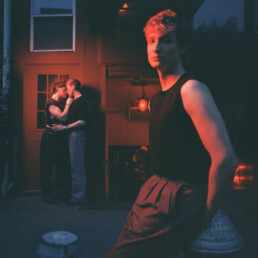
When Kevin Atwater writes an album, he makes more than music. He builds an entire world, one that the listener falls into without trying and without fully realizing the detail of the art around them until they look up surrounded by a blush-colored haze of love, limerence, and loss.
Atwater’s newest record, Blush Red, is “a very loose concept album” that tells a story of falling and crashing and picking yourself up again. In Atwater’s own words, the thesis of the album lies in the idea of “learning how to allow desire and shame to live in your body but not dictate everything that you do. Learning how to keep them as parts of you and live with them and not let them force you to move through your life in any sort of way.”
Blush Red unpacks the layered feelings of falling and healing, of learning to live with desire and shame as two sides of the same coin. Each song Atwater wrote for the record pulls from a specific feeling, some finding inspiration from true stories and others from more abstract concepts. Regardless of its origin, each track adds a new layer to the album’s overall story.
“I didn’t write [these songs] with the intention of them all being about the same person… but I think in the context of the album, it feels very much like it could be. And that to me is exciting, especially in just letting the songs sort of transform for whoever’s listening… obviously we haven’t all been through the exact same circumstances, and that’s the cool thing about music, it can sort of mean what you want it to mean.”

Atwater’s writing process starts at the guitar, messing around with chords and melodies until he finds something that hits an emotional note and then letting that feeling inform the story. Atwater also pulls inspiration from theatre, film, poetry in his songwriting; he went to college for theatre, and still returns to those roots when writing music.
“When I have multiple parts singing over each other, I’m thinking of it in a theatrical way… Like this character would be here singing this, and then the other voices are other people in my head. I like to go back to the roots when I’m writing music and when I’m writing harmonies.”
“Theater is actually a huge huge part of my life. I love musicals and I go back to them. I honestly draw from this musical Spring Awakening, which is my favorite musical of all time. I draw from that in my music still.”
In addition to theatrical inspirations, Atwater also mentions Andrew Hay’s film Weekend and Richard Silken’s poetry book Crush, citing the latter as a massively impactful work not only for the way it inspired the album, but also for the impact it had on him as a person.
“I’m not even kidding, I’ve read it like 15 times and annotated the whole thing… I’ve never really read a collection of poetry that has moved me in that way… I was crying and being really moved to write, which is like something that I haven’t experienced with poetry before. I’m always drawing inspiration from the poems in that book… a lot of this album ties back to that book because the book is a lot about desire and shame and like the tragedy of wanting someone so badly that it hurts. It hurts your body physically. A crush is like, “oh, I have a crush,” but like it’s a crushing feeling, which is really cool. And I think even just starting there, I was like, “I’d love to write like a whole album just about desire and wanting someone, which a lot of my music is about that anyway.”
Pulling inspiration from other art forms helped Atwater develop an incredibly cohesive visual around this record. Every visual element of the album ties back to a larger theme or motif from within the music – moody photography, lyric teases formatted like annotated movie scripts, short films instead of music videos, a tracklist reveal hidden in stickers lining a greenroom mirror.
“My songs have these stories that are very specific to me… the stories of the songs typically feel like I got across what I wanted in them. And how cool would it be to explore that message in a different medium? A story that is not the same but is adjacent to the meaning of it.”

Pulling inspiration from life and art in an abstract, present tense is what brought Blush Red to life, but it’s a relatively new method of creating for Atwater, who recalls that his past work “was very much mining the past.” Other than confessing that the tracks on his sophomore record didn’t originate from a singular muse, he hesitates to delve into too much detail on the specific situations that inspired them.
“This is more of a current album in my life so I’m a little more protective of it because of that. It’s all coming from a really personal place and they’re all true stories, but I’m not going to give you the context… I’m a little more protective of the people too because this also feels very much so like an album that happens after my last one, which is good because it is an album that comes after, but the songs to me are very much taking place more in the present.”
When the story of the album takes place in one night, that sense of the present is, well, extremely present. The songs play out somewhat chronologically, and Atwater’s favorite track, titled God in My Head, acts as the turning point in the story, the last song on the A side before the record flips.
“The song includes the admission to this person that you’ve been wanting so badly, like the telling of it is in the song which I think is kind of cool… The song happens right in the center of the album too and then the rest of the album is the fallout from letting this person know how you feel. Which is a scary thing to do in an album cause this song also is one of the super unstructured ones.”
“It’s definitely the craziest song I’ve written. It took so long to make because no one understood. I was like, “This is what it’s gonna be.” And my producer was like, “I’m down, but I have no idea what you mean.” I was like, “You will in a few months when it’s done.” And it’s now both of our favorite songs on the album.”
“hero into lover feels so good in your head, till they leave you just to save you, just to leave you again”
– Kevin Atwater, God In My Head
Across every track, Blush Red plays with desire in its best and worst forms, its overarching themes present in every song and surrounding visuals. With his sophomore album, Atwater has succeeded in documenting the emotional rollercoaster of falling in and out of crushing infatuation in a way that is both breathtakingly poetic and achingly relatable.
“I’m not trying to tell anyone what to do or how they should feel listening to it or what is the right way to go about completely destroying yourself for someone. It’s more of just being like – ‘this is how complicated it feels to want somebody so badly. Here is everything that is messy about this and I hope that you can see yourself in it.’”
Blush Red is available everywhere as of July 10, 2026. Listen to the album on Spotify and Apple Music, keep up with Kevin on Instagram and Tiktok, and find upcoming tour dates here.